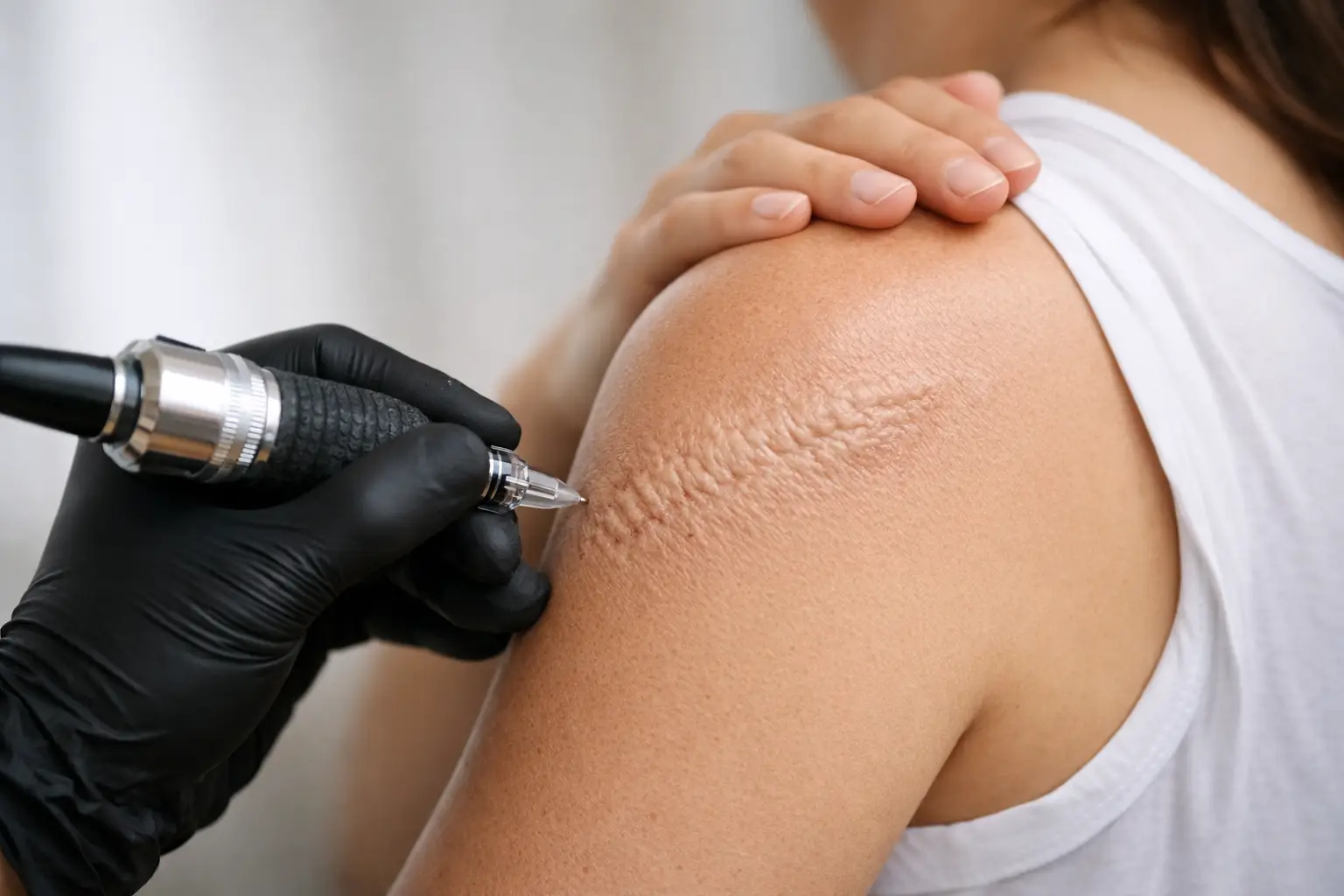
Inkless Tattoo for Textured Scars Explained
A scar can be completely healed and still feel like it announces itself every time light catches it. It may pull, dip, feel firm, or sit above the surrounding skin. An inkless tattoo for textured scars is designed to support the appearance and quality of scar tissue without adding camouflage pigment. For the right candidate, it can be a meaningful part of feeling more comfortable in their skin again. But texture is complex, and a thoughtful assessment matters far more than a one-size-fits-all treatment.
What an inkless tattoo is designed to do
Unlike scar camouflage, which uses carefully blended pigment to reduce contrast between a scar and surrounding skin, inkless tattooing does not place color into the skin. A specialized tattoo device is used to create controlled microchannels in the scarred area, often alongside a topical serum selected for the skin’s needs.
The treatment is sometimes described as scar revision or needling-based scar support. The goal is not to erase a scar or promise perfectly smooth skin. Rather, the controlled process is intended to encourage the skin’s natural remodeling response, helping some scars look and feel softer, more even, and less visually disruptive over time.
That distinction is especially important for textured scars. Pigment can address color contrast, but it cannot reliably correct a raised, indented, tight, or uneven surface. In some cases, improving texture first creates a better foundation for future camouflage tattooing. In others, texture improvement alone may be the more appropriate goal.
Which textured scars may be candidates?
Textured scars do not all behave the same way. A scar from a tummy tuck, breast surgery, injury, burn, acne breakout, or C-section can respond differently based on its location, depth, age, and the way the individual body heals. The surrounding skin also matters.
A mature scar that is pale, firm, slightly raised, indented, or irregular in texture may be considered for inkless tattooing after a detailed evaluation. Stretch marks can also be assessed, particularly when they are fully healed and no longer actively changing. The best treatment plan depends on whether the concern is texture, color, tightness, or a combination of all three.
Raised scars deserve particular caution. Hypertrophic scars remain within the borders of the original wound but can be thick, elevated, and sensitive. Keloids extend beyond those original borders and may continue growing. Because stimulating scar tissue can be inappropriate for someone prone to keloid formation, these scars require medical guidance and may not be suitable for inkless tattoo treatment.
Deeply tethered scars, scars with significant contracture, or scars that cause pain or restricted movement should also be evaluated by a physician. A paramedical tattooing specialist can help address cosmetic concerns, but treatment should never replace medical care when function or active scar complications are involved.
Timing is part of the treatment
A scar should be fully closed, stable, and mature before treatment. That usually means waiting at least 6 to 12 months after surgery or injury, although healing timelines vary. Some scars need longer, particularly after reconstructive surgery, radiation, infection, or a complicated healing process.
A mature scar is typically no longer red or actively inflamed. It has settled into its longer-term appearance, even if it remains lighter or darker than the surrounding skin. Beginning too early can place unnecessary stress on healing tissue and makes results harder to predict.
For clients recovering from plastic surgery, mastectomy, breast reconstruction, or medical treatment, clearance from the surgeon or treating physician may be requested. This is not a barrier to care. It is a way to protect the work already done and ensure your restorative plan respects your medical history.
What happens during an inkless tattoo consultation?
The consultation is where precision begins. Scar treatment should be planned around your skin, not copied from someone else’s before-and-after photo. A specialist examines the scar’s location, thickness, flexibility, color, sensitivity, and age, along with your history of healing and any previous treatments.
Your Fitzpatrick skin type is also part of the conversation. Skin can react to trauma with temporary or persistent changes in pigment, particularly when there is a history of post-inflammatory hyperpigmentation. This does not automatically rule out treatment, but it may influence technique, treatment spacing, and expectations.
You should be prepared to discuss medications, allergies, autoimmune conditions, diabetes, active skin concerns, pregnancy or nursing status, and any tendency toward abnormal scarring. A reputable practitioner may ask for physician clearance when appropriate. Honest information creates a safer plan and helps avoid treating skin that needs more time or medical oversight.
At Fancy Shmancy, this planning is approached with the same care used for restorative pigmentation work: an assessment of anatomy, skin behavior, and the result that will serve you best. Sometimes the right recommendation is inkless tattooing. Sometimes it is scar camouflage later, another aesthetic modality, or simply more healing time.
What results can you realistically expect?
Results develop gradually. The skin’s response to controlled needling is not immediate, and the treated area can look temporarily red, feel tender, or appear more noticeable during the early healing phase. As the area settles, some clients notice that the scar looks less dense, more blended, or smoother in certain lighting.
The degree of change depends on the scar. A shallow surgical scar may respond differently than a deep traumatic scar. A long-standing, thick scar may improve in softness without becoming flat. An indented scar may look less abrupt but still retain some shadow. Realistic expectations protect your investment and honor the fact that scars are living tissue, not marks that can simply be switched off.
More than one session is often recommended. Treatments are typically spaced to give the skin time to recover and reveal its response before another session is considered. A practitioner who promises a complete transformation in one appointment is not acknowledging the biology involved.
There are trade-offs to consider. Inkless tattooing may improve texture but does not add color to a pale scar. Scar camouflage may improve the visual contrast of a pale scar but can be challenging when the surface is significantly raised or uneven. Combining approaches in the right order can be beneficial, but only after the tissue is stable and the skin has responded well to each stage.
Pre-care and aftercare protect your outcome
Scar tissue deserves a calm, controlled appointment and equally attentive aftercare. Before treatment, clients are commonly asked to avoid sun exposure, tanning, retinoids near the treatment area, alcohol, and blood-thinning products when medically safe to do so. Do not discontinue prescribed medication without instruction from your physician.
After treatment, keep the area clean and follow the personalized instructions provided by your practitioner. Avoid picking, friction, swimming, hot tubs, excessive sweating, and direct sun exposure during the recommended healing period. The skin may flake or feel dry as it recovers. Let that process happen naturally rather than trying to speed it up.
Sun protection remains especially valuable once the area has healed. Ultraviolet exposure can make scars and surrounding skin look more uneven over time, which can affect the appearance of your result.
Choosing a specialist for textured scar work
Inkless tattooing for scars is not a standard beauty service. It requires an understanding of skin anatomy, scar behavior, sterile technique, pigmentary risk, and the emotional weight many clients carry into the appointment. The procedure may look simple from the outside, but the judgment behind it is what helps keep treatment conservative, personalized, and appropriate.
Look for a practitioner who asks detailed questions, reviews contraindications, explains what the treatment can and cannot do, and never pressures you to treat before your skin is ready. Before-and-after images can be helpful, but your consultation should center on your own scar, healing history, and goals.
A scar may always be part of your story. That does not mean it has to remain the first thing you see. With patience, medical awareness, and an individualized plan, you can make choices that support skin that feels more like your own.
Author: Liana Reznik