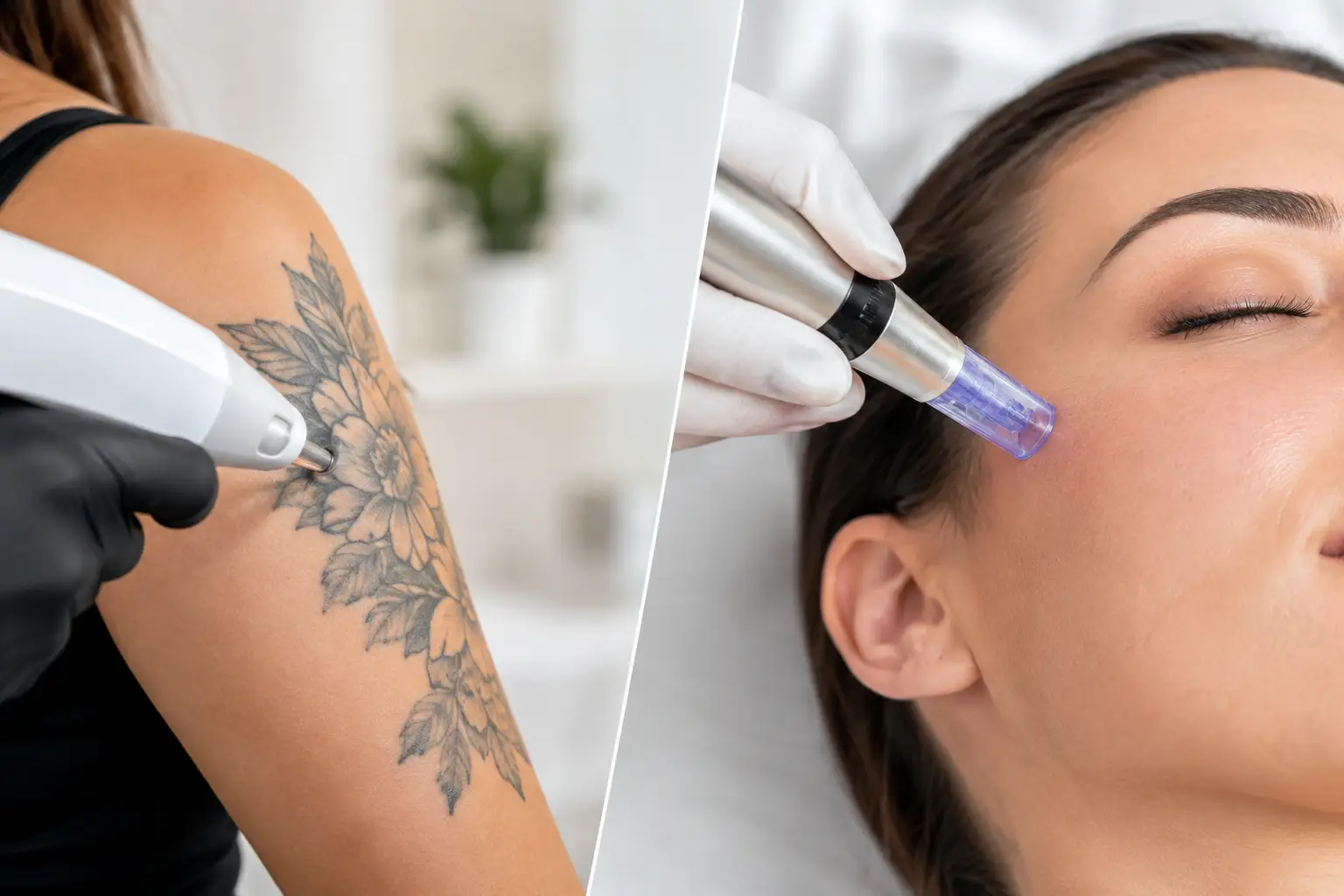
Inkless Tattoo Versus Microneedling Compared
A scar or stretch mark can hold far more than a visible change in the skin. It may represent surgery, pregnancy, weight change, injury, or a chapter you did not choose. When clients ask about inkless tattoo versus microneedling, they are usually asking a deeply practical question: which treatment can help the skin look smoother, more even, and less distracting without changing who they are?
The answer depends on the area, the age and texture of the concern, your skin tone and healing history, and the result you hope to see. Both treatments use controlled needling to encourage the skin’s natural repair response. Yet they are not interchangeable procedures, and neither should be approached as a quick fix.
Inkless Tattoo Versus Microneedling: The Core Difference
An inkless tattoo is a paramedical technique that uses tattoo-style needling without depositing traditional pigment. The goal is to create controlled micro-injuries within a scar or stretch mark so the body can begin a focused healing and remodeling process. Depending on the practitioner’s protocol, a professional topical solution may be used during the treatment. The needling pattern, depth, pressure, and pace are adjusted to the specific skin concern.
Microneedling also creates controlled microchannels in the skin, most commonly with a pen-style device. It is typically used more broadly for concerns such as fine lines, enlarged pores, mild texture irregularities, acne scarring, and overall skin quality. It can be performed across larger facial or body areas in a consistent, systematic pattern.
The distinction is less about one treatment being inherently better and more about treatment intent. Inkless tattooing is often highly targeted for individual scars and stretch marks, particularly when a provider is assessing how altered skin behaves. Microneedling is often a wider skin-rejuvenation treatment designed to support collagen production and improve general texture.
What Each Treatment May Help Improve
Neither inkless tattooing nor microneedling can promise to erase a scar or make stretch marks disappear. Mature scar tissue has a different structure from surrounding skin, and healing is influenced by genetics, hormones, skin condition, medical history, and aftercare. A responsible provider sets expectations around improvement, not perfection.
Inkless tattooing may be a thoughtful option for certain healed surgical scars, trauma scars, burn scars, and stretch marks that feel indented, uneven, or visibly different in texture. Because it is focused on a specific concern, it can be tailored more precisely around the border, direction, and density of the scar tissue. It does not add color, which matters for clients who want to address texture before considering scar camouflage or who are not candidates for pigment work.
Microneedling may be better suited to diffuse concerns. For example, someone with mild acne scarring across the cheeks, fine lines around the mouth, or a broad area of uneven texture may benefit from a treatment that addresses the surrounding skin as well as the concern itself. It can also complement a larger skin-care plan when performed at appropriate intervals.
For stretch marks, the choice is particularly individual. Newer stretch marks may still have red, purple, or pink tones, while older marks are often lighter and more established. Their location, width, depth, and your Fitzpatrick skin type all affect the recommended approach. A treatment plan that works beautifully for abdominal stretch marks may not be appropriate for the breasts, hips, thighs, or a darker skin tone without careful adjustment.
Technique Matters More Than the Trend
It is easy to compare these services as if the treatment name alone determines the outcome. In reality, the person performing the procedure has a significant influence on safety and results.
Scar tissue is not ordinary skin. It may be thicker, thinner, raised, tethered, numb, sensitive, poorly vascularized, or unpredictable in how it heals. Needling too aggressively can create unnecessary inflammation. Treating too superficially may not provide meaningful improvement. A practitioner needs to recognize the difference, evaluate the area in person or through a detailed virtual consultation, and determine whether the concern is stable enough for treatment.
At Fancy Shmancy, this assessment is grounded in medical aesthetics experience, skin anatomy knowledge, and an understanding of how different Fitzpatrick skin types may respond. The treatment itself is only one part of the process. Pre-care, thoughtful pacing, hygiene, and aftercare all protect the quality of the result.
Inkless Tattooing Is Not Simply a Tattoo Without Ink
The name can be misleading. An inkless tattoo is not a cosmetic tattoo appointment with pigment removed from the equation. When used for scars and stretch marks, it is a restorative treatment requiring a different level of judgment. The provider must understand the history of the area, how long it has been healed, and whether the tissue is appropriate for controlled stimulation.
A scar following surgery, for instance, should generally be fully healed and medically cleared before any needling is considered. If you are recovering from mastectomy, reconstruction, an injury, or another medical procedure, the timing should be coordinated with your surgeon or medical provider. A careful practitioner will never rush this step for the sake of an appointment.
Microneedling Is Not One-Size-Fits-All Either
Microneedling devices offer adjustable depths, but deeper does not automatically mean better. The right setting varies by body area, concern, skin thickness, and healing capacity. Facial skin, neck skin, décolletage skin, and post-surgical tissue each call for a different approach.
Quality microneedling should include a clean treatment environment, sterile single-use components where appropriate, a thorough health review, and clear instructions for recovery. A device alone is not a treatment plan.
Healing, Downtime, and Sessions
Both treatments create a temporary inflammatory response. Redness, warmth, tenderness, tightness, and mild swelling can be expected after a properly performed session. On the face, redness may resemble a sunburn for a day or two. On the body or over scar tissue, recovery can vary more widely.
Inkless tattooing may leave the treated scar or stretch marks visibly red or darker for a period while the skin recovers. This temporary change can be emotionally challenging, especially if the area is already a source of self-consciousness. The final result should not be judged while the tissue is still actively healing. Collagen remodeling takes time, often several weeks to months.
Microneedling also works gradually. Many clients need a series of sessions, spaced apart to allow the skin to recover and respond. The number of treatments depends on the concern, the area, and how the skin progresses. Be cautious of anyone who guarantees a certain number of sessions or promises dramatic correction after one visit.
Aftercare is intentionally simple but essential. Keep the area clean, avoid picking or friction, protect it from direct sun, and follow the exact product guidance provided by your practitioner. Exercise, swimming, saunas, active skincare ingredients, and restrictive clothing may need to be paused briefly, depending on the treatment area.
When Neither Treatment Is the Right First Step
A consultation should identify situations where it is better to wait, modify the plan, or choose another treatment entirely. Active infection, open wounds, active inflammatory skin conditions in the treatment area, and a history of abnormal scar formation require extra caution. Pregnancy, recent surgery, certain medications, autoimmune conditions, and a tendency toward post-inflammatory hyperpigmentation may also affect candidacy.
Raised, painful, itchy, or changing scars should be evaluated by a medical professional before cosmetic or paramedical treatment. The same is true for scars that have not fully matured. The most affirming choice is sometimes to protect your healing process by waiting.
Choosing the Treatment That Supports Your Goals
If your primary concern is a localized, fully healed scar or stretch mark and you want a highly customized approach without pigment, inkless tattooing may be worth discussing. If your goal is broader improvement in skin texture, fine lines, pores, or mild scarring across a larger area, microneedling may better fit your needs.
Some clients may benefit from a phased plan. Texture can be addressed first, then reassessed before considering scar camouflage, stretch mark camouflage, or other restorative pigmentation. Others may decide that their skin needs medical care, time, or a less intensive approach. There is no single “best” procedure, only the one that makes sense for your skin and your story.
The right treatment should leave you feeling informed, respected, and cared for long before the first needle touches the skin. A detailed consultation creates space for honest questions, realistic expectations, and a plan that honors both your desired result and your body’s ability to heal.
Author: Liana Reznik