Post Mastectomy Tattoo Examples That Feel Like You
For many people, the final stage of breast reconstruction is not another surgery. It is a carefully considered choice about how they want to see themselves. Post mastectomy tattoo examples can offer a starting point, whether your goal is realistic 3D areola restoration, a meaningful artistic design, or a gentler way to bring attention away from scars.
There is no single “right” result after a mastectomy. Some clients want a highly natural nipple and areola effect that looks dimensional even though the skin remains flat. Others prefer florals, fine-line work, or a design that turns a surgical scar into part of their story. The best choice is personal, and it should be approached with the same care, precision, and sensitivity as any other part of your recovery.
3D Areola Restoration: The Most Natural-Looking Option
Among post mastectomy tattoo examples, 3D areola and nipple tattooing is often the choice for clients who want visual restoration without additional nipple reconstruction surgery. Using advanced shading, highlights, undertones, and precise pigment placement, a trained paramedical tattoo artist creates the optical impression of projection on a flat surface.
The result is not a generic circle of color. A thoughtful treatment considers the size, placement, shape, edge softness, color variation, and texture that will look most believable on your body. If one breast has retained its natural nipple and areola, the tattoo can be customized to complement it. If both breasts have been reconstructed, the design can be created for balance while still avoiding an overly identical or artificial appearance.
A realistic areola tattoo may include subtle details such as Montgomery glands, soft pigment transitions, and carefully placed highlights. These details matter because natural anatomy is not perfectly uniform. The most successful results tend to look quietly convincing rather than heavily outlined or overly saturated.
When 3D Tattooing May Be a Better Fit Than Reconstruction
Some clients choose 3D areola tattooing after implant or flap reconstruction because they do not want another procedure, recovery period, or change in sensation. Others have already had nipple reconstruction but want tattooing to add color, definition, and realism. In both cases, the goal is often the same: to feel more complete when looking in the mirror, getting dressed, or being intimate.
Timing matters. Your surgeon should confirm that incisions are fully healed and that your skin is ready for treatment. Radiation, ongoing cancer treatment, scar maturity, medications, and changes in breast shape can all affect the appropriate timeline and the way pigment heals.
Decorative Tattoos That Honor the Scar
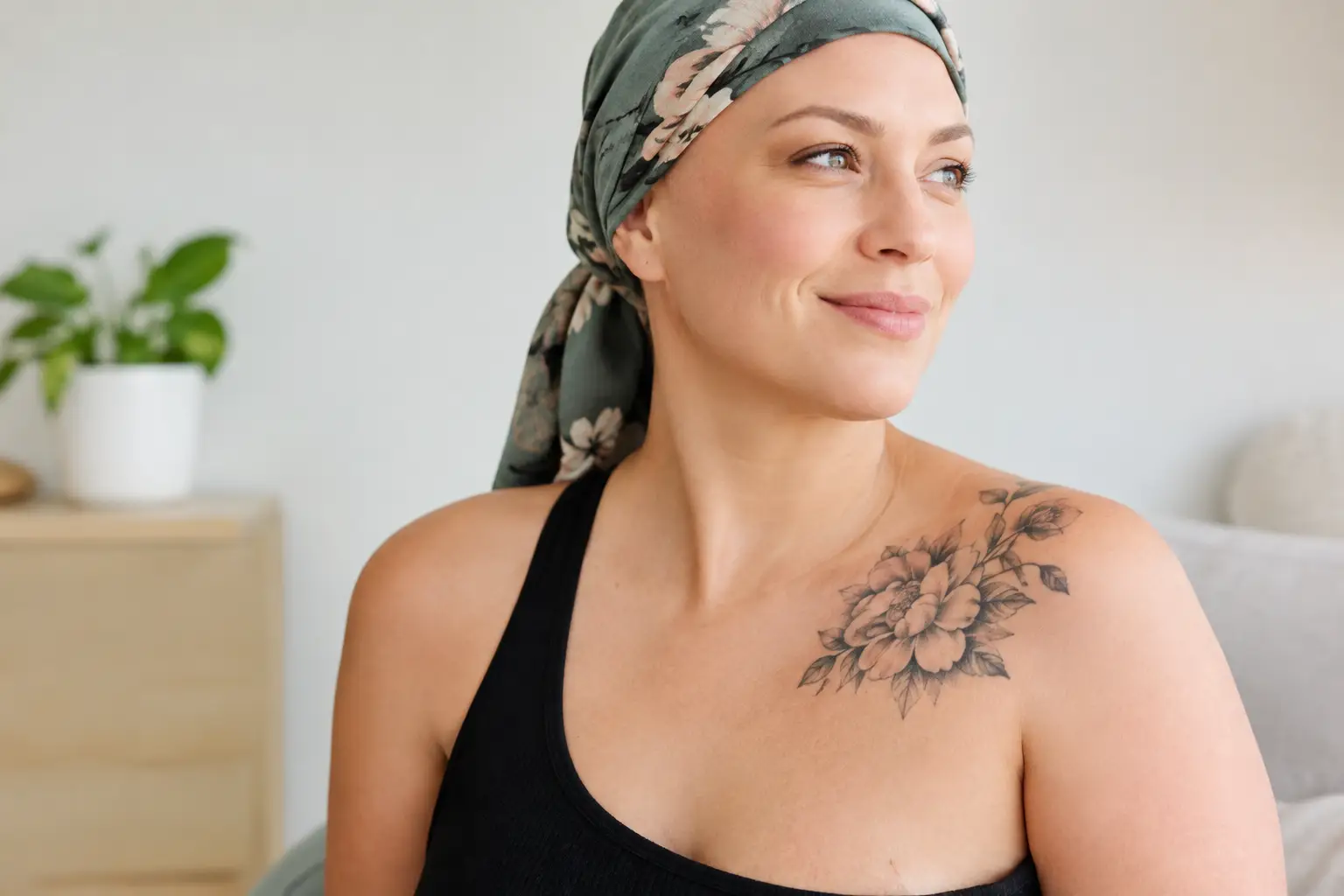
Not every post-mastectomy tattoo needs to resemble anatomy. Decorative work can be a powerful choice for someone who wants a design that feels expressive, private, celebratory, or simply beautiful. In these examples, the scar may be incorporated into the artwork, softened by surrounding imagery, or left untouched while the tattoo creates a new focal point.
Botanical designs are especially popular because stems, leaves, and blossoms can follow the natural direction of a scar or frame the chest in a flattering way. A branch of wildflowers may symbolize renewal. A single bloom can feel restrained and elegant. Larger floral compositions can create visual movement across one or both sides of the chest.
Some clients prefer designs with personal meaning: a favorite bird, celestial imagery, an abstract watercolor-inspired composition, a meaningful phrase, or a symbol connected to family, faith, survival, or personal identity. The most enduring choice is rarely the trendiest image. It is the design that still feels true to you after the intensity of treatment and recovery has passed.
Scar-Focused Versus Scar-Adjacent Designs
A scar-focused tattoo intentionally incorporates the scar into the composition. For example, a vine may appear to grow along a linear scar, or delicate shading may visually integrate the area into a larger design. This approach can be beautiful, but it requires an artist who understands how scar tissue behaves and how to design around uneven texture.
A scar-adjacent tattoo sits near the surgical area without placing ink directly into the scar. This may be preferred when scars are still sensitive, when tissue is especially delicate, or when a client wants the freedom to acknowledge the scar without making it the center of the design. Neither approach is better. It depends on healing, skin quality, comfort level, and your vision.
Minimalist and Symbolic Post Mastectomy Tattoo Examples
A small tattoo can hold just as much meaning as a larger chest piece. Minimalist options often appeal to clients who want something refined and personal rather than highly visible. A tiny heart, a delicate outline of a flower, a date, initials, or a subtle linework design may be placed close to the scar or in a location chosen for privacy.
These designs can feel especially right for someone who is not looking to cover or disguise anything. Instead, they mark a turning point. They can also work well after a unilateral mastectomy, when a client wants to create visual balance without matching the remaining breast or adding a full decorative design.
Minimal does not mean simple from a technical standpoint. Fine lines, pale skin, thin post-surgical tissue, and changes in skin texture all require intentional planning. A skilled artist will be honest about what will heal cleanly and what may need to be adapted for longevity.
What Makes a Post-Mastectomy Tattoo Successful
The most moving before-and-after transformations are not defined by a particular style. They are defined by careful collaboration. Your artist should begin with a detailed consultation that makes room for your medical history, reconstruction type, scar pattern, skin tone, Fitzpatrick skin type, sensitivities, and emotional goals.
For 3D areola work, color selection is especially individualized. The same pigment can heal differently depending on undertones in the skin, scar tissue, and prior radiation. Many clients need more than one session to build dimension or refine color after healing. This is normal, not a sign that something went wrong.
For decorative tattoos, design placement should respect the contours of the reconstructed breast and the way the body moves. What looks balanced while lying down or sitting in a consultation may need adjustment when standing. This is why a transfer, mapping process, and time for feedback are essential before tattooing begins.
Cleanliness and clinical awareness are also nonnegotiable. A post-surgical chest is not an ordinary tattoo canvas. Choose a practitioner with specific experience in paramedical tattooing, a thorough sanitation protocol, and a willingness to coordinate with your plastic surgeon or medical team when appropriate.
Questions to Consider Before Choosing a Design
Before bringing in inspiration photos, give yourself permission to think beyond appearance. Do you want this tattoo to restore a familiar part of your body, create a new visual story, or simply help you feel more at ease? Would you like the result to be visible in a mirror, hidden under most clothing, or somewhere in between?
It also helps to consider your comfort with maintenance. A realistic areola tattoo may require a touch-up as pigment settles or fades over time. Decorative tattoos can also fade, particularly in areas affected by radiation or significant changes in weight. Protecting treated skin from sun exposure and following aftercare closely supports better healing and longer-lasting color.
Bring reference images, but do not feel pressure to duplicate someone else’s result. Post mastectomy tattoo examples are useful for discovering possibilities, not for setting a standard your body must meet. Your skin, scars, anatomy, and healing journey are uniquely yours.
A Gentle, Expert-Led Next Step
At Fancy Shmancy, restorative pigmentation is approached as both an art and a deeply personal milestone. A private consultation offers space to discuss what feels right, ask practical questions, and develop a plan that respects your body and your medical history.
You do not need to decide immediately whether you want a realistic areola tattoo, an artistic scar design, or no tattoo at all. When the time is right, choose the option that helps you feel most at home in your body – on your own terms.
Author: Liana Reznik